
How to Recognize Ancient Greek Temples Through Doric, Ionic, and Corinthian Styles
Stand in front of the Parthenon for the first time and you'll probably sense something - a feeling of solidity, of weight held perfectly in balance. Then look at a photo of the Erechtheion nearby and it feels different. Lighter, somehow. More refined. Walk through the ruins of Olympia and you'll find something else again: columns so richly decorated they almost seem excessive.
There's a reason for that. Ancient Greek architects worked within three distinct visual systems called orders - Doric, Ionic, and Corinthian - each with its own proportions, column shapes, and decorative logic. Once you know what to look for, reading a Greek temple becomes surprisingly straightforward.
This article breaks down each order by its defining features, explains the mood or character each one projects, and shows you how to spot them in some of the most famous surviving temples. By the end, you'll have a reliable eye for Greek architecture wherever you encounter it.
How Doric, Ionic, and Corinthian Styles Differ
We tend to see ancient Greek architecture as columns, each a symbol of a different architectural philosophy. The Dorian, Ionic and Corinthian orders, simply structural solutions, express proportion, decoration, and cultural priorities as well. To be able to discern the one from the other aids in reading a temple or ruin with a good deal more understanding, even without any training in architecture.
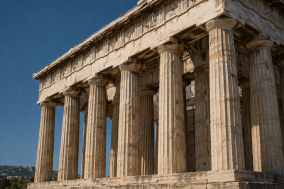
Doric: Built to Impress Through Simplicity
Stocky, unadorned, and planted firmly on the ground - that's your first clue you're looking at a Doric column. There's no base; the shaft rises straight from the temple's floor platform. At the top, the capital is a plain, flat slab sitting on a simple circular cushion. The Parthenon is the obvious example, and the Temple of Hephaestus in Athens shows it just as clearly. Look for the sense of solidity. Doric temples feel grounded, almost heavy.
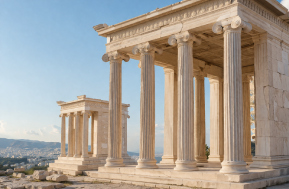
Ionic: Slimmer, Softer, More Refined
Scroll to the capital and you'll spot the difference immediately. Those paired spiral curls - called volutes - are the Ionic order's signature. The columns are noticeably slimmer and stand on a layered base, unlike Doric shafts. The Erechtheion and the Temple of Athena Nike both show this style well. Ionic temples carry a lighter, more graceful feeling.
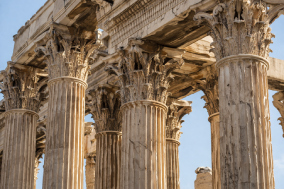
Corinthian: All About the Capital
Rare in major Greek temples but hard to miss when present, the Corinthian order announces itself through its elaborate capital, carved with layered acanthus leaves that fan outward and upward. The Temple of Olympian Zeus in Athens is the clearest Greek example. Spot the foliage first - nothing else looks quite like it.
Why These Temple Styles Still Matter Today
Beyond the decorative aspect, each order opens up meaning. Doric columns were about power and civic purpose-the Parthenon was never just a building, but rather an assertion of Athens' power. Ionic orders suggested a more refined and intellectual culture, preferred in Asia Minor-like places where rival cities vied for prestige. Lastly, Corinthian goes beyond anything that might be ascribed to it, given its elaborate capitals and acanthus leaves, asserting the wealth and ambition of its builder.
Roman builders took on all three forms and spread them from this huge empire. These were later picked up by Renaissance architects from Roman ruins and placed on counts, palaces, and long linear churches across Europe. Today you across seats a Corinthian column on the U. S. Supreme Court, Ionic on the British Museum, and Doric on war memorials from Washington to Edinburgh. There is hardly a contest against these valuable forms by imparting to the architects a certain applicable authority that they keep striving to reach.
Once You See the Orders, Temples Change Completely
The three orders give texture to a wall of ancient stone, letting it speak to you. Doric, Ionic, and Corinthian are not purely technical terms; they are a shorthand telling you without further ado whether the structure wanted to express sheer strength, a graceful sense of selection, or legitimate grandeur. Cast glances over the base of the column once, run your eyes up the shaft, and then stop at the capital. No base says Doric. Rolled leaves mean Ionic. A dense capital of carved leaves means the Corinthian. After that point, life in front of the Parthenon or the Temple of Olympian Zeus will always have a peculiar pull to you. So many things come to light before your eyes once you share with the building beyond their affixed roles. A building may reveal all sorts of aspects with a proper exposure, but what you first perceive is their relationship between the column and interior handiwork/design of choice practiced so ethically by the architects across so many centuries.
Our Partners